
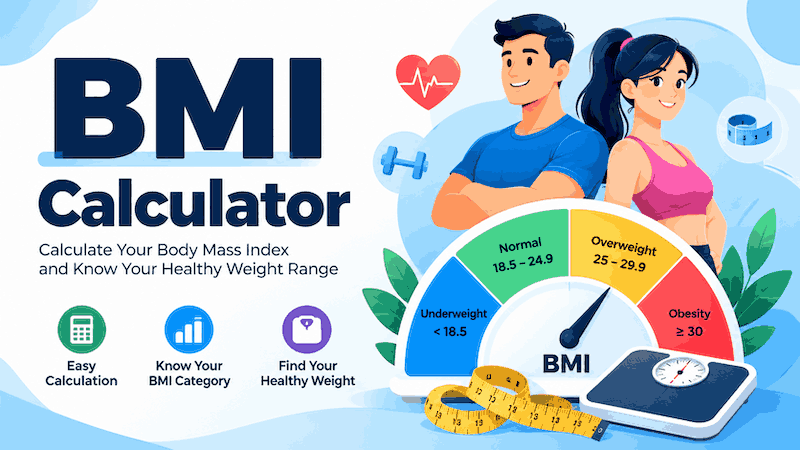
Body Mass Index Calculator
BMI Calculator
Calculate your Body Mass Index
BMI Classification
| Category | BMI |
|---|---|
| Severe Thinness | < 16 |
| Moderate Thinness | 16 – 17 |
| Mild Thinness | 17 – 18.5 |
| Normal | 18.5 – 24.9 |
| Overweight | 25 – 29.9 |
| Obese Class I | 30 – 34.9 |
| Obese Class II | 35 – 39.9 |
| Obese Class III | 40+ |
Use our free BMI Calculator to calculate your Body Mass Index quickly and easily. Enter your age, gender, height, and weight to find your BMI and understand which BMI category you fall into.
Our calculator supports Metric Units (kg/cm), US Units (lb/ft/in), and other measurement options, making it convenient for users around the world.
What Is BMI?
BMI, or Body Mass Index, is a numerical value calculated using a person's height and weight. It is commonly used as a screening tool to classify weight in adults.
The standard BMI formula is:
BMI = Weight (kg) ÷ Height² (m)
For example, if a person weighs 70 kg and is 175 cm tall:
BMI = 70 ÷ (1.75 × 1.75) = 22.9
A BMI of 22.9 falls within the standard normal-weight range for adults.
BMI Categories for Adults
For most adults, BMI is commonly interpreted using the following categories:
| BMI | Category |
|---|---|
| Below 18.5 | Underweight |
| 18.5 – 24.9 | Normal Weight |
| 25.0 – 29.9 | Overweight |
| 30.0 – 34.9 | Obesity Class I |
| 35.0 – 39.9 | Obesity Class II |
| 40 or above | Obesity Class III |
These categories are intended for general screening and should not be considered a diagnosis.
Why Use a BMI Calculator?
A BMI calculator provides a quick way to understand how your weight relates to your height. It can be useful as a starting point when monitoring your weight or discussing your health with a qualified healthcare professional.
You can use our calculator to:
- Calculate your BMI instantly
- Check your general BMI category
- Estimate a healthy weight range for your height
- Calculate BMI using kilograms or pounds
- Calculate BMI using centimeters, feet/inches, or inches
- Compare your BMI over time
How Is BMI Calculated?
The calculation depends on the units you use.
Metric Formula
When weight is measured in kilograms and height in meters:
BMI = Weight ÷ Height²
Example:
Weight: 80 kg
Height: 1.80 m
BMI = 80 ÷ (1.80 × 1.80) = 24.7
US Units Formula
When weight is measured in pounds and height in inches:
BMI = 703 × Weight (lb) ÷ Height² (in)
For example, a person weighing 176 lb and measuring 70 inches tall would have a BMI of approximately 25.3.
What Is a Healthy BMI?
For adults, a BMI between approximately 18.5 and 24.9 is generally classified as the normal or healthy BMI range.
However, a BMI number should not be viewed in isolation. Factors such as muscle mass, body-fat distribution, age, sex, waist circumference, and overall health can affect how meaningful BMI is for an individual.
Healthy Weight Range
Your healthy weight range can be estimated by calculating the weights corresponding to BMI values of 18.5 and 24.9 for your height.
For example, for someone who is 175 cm tall, the approximate weight range corresponding to a BMI of 18.5–24.9 is around 56.7–76.3 kg.
This is an estimate based on BMI and should not be interpreted as a personalized medical target.
BMI Prime
BMI Prime is another way of expressing BMI. It compares a person's BMI with a reference BMI of 25.
BMI Prime = BMI ÷ 25
For example:
If your BMI is 22.5:
BMI Prime = 22.5 ÷ 25 = 0.90
A BMI Prime below 1 means the BMI is below 25, while a value above 1 means it is above 25.
What Is the Ponderal Index?
The Ponderal Index (PI) is another height-and-weight-based measurement. It is similar to BMI but uses height cubed rather than height squared.
The metric formula is:
Ponderal Index = Weight (kg) ÷ Height³ (m)
Like BMI, the Ponderal Index is a mathematical screening measure and does not directly measure body fat.
BMI Does Not Directly Measure Body Fat
One of the most important limitations of BMI is that it does not directly measure body fat.
For example, a person with significant muscle mass may have a relatively high BMI despite having a relatively low body-fat percentage. Conversely, someone with a normal BMI may still have a relatively high percentage of body fat.
BMI also does not show where fat is stored in the body.
For a more complete assessment, other measurements such as waist circumference, body-fat percentage, physical activity, blood pressure, and metabolic health may also be considered.
BMI for Children and Teenagers
Adult BMI categories should not simply be applied to children and teenagers.
For people between approximately 2 and 20 years old, BMI is generally interpreted according to age- and sex-specific growth charts or percentiles because body composition changes considerably during childhood and adolescence.
If you are calculating BMI for a child or teenager, consult an appropriate pediatric growth reference or healthcare professional.
Is BMI Accurate?
BMI is useful because it is simple, inexpensive, and easy to calculate. However, it has limitations.
BMI does not account directly for:
- Muscle mass
- Body-fat percentage
- Bone density
- Fat distribution
- Waist circumference
- Differences in body composition
Therefore, BMI should be considered a screening measurement rather than a complete assessment of health or body composition.
Frequently Asked Questions
What does BMI stand for?
BMI stands for Body Mass Index. It is a number calculated from height and weight and is commonly used to classify weight categories in adults.
What is a normal BMI?
For adults, a BMI from approximately 18.5 to 24.9 is generally classified as normal weight.
Is a BMI of 25 overweight?
Under standard adult BMI categories, a BMI of 25 or above falls into the overweight range.
Is BMI the same for men and women?
The standard adult BMI calculation is the same for men and women. However, body composition can differ between individuals, so BMI should be interpreted alongside other factors.
Can muscular people have a high BMI?
Yes. BMI does not distinguish between muscle and fat. A muscular person can have a high BMI without having excessive body fat.
Can I calculate BMI using pounds and inches?
Yes. Use the US Units option in our calculator to enter your weight in pounds and height in feet and inches.
Can I calculate BMI using kilograms and centimeters?
Yes. Select Metric Units, enter your weight in kilograms and height in centimeters, and the calculator will calculate your BMI automatically.
Does BMI tell me how much body fat I have?
No. BMI is calculated from height and weight and does not directly measure body-fat percentage.
Important Health Disclaimer
This BMI calculator is provided for general informational and educational purposes. BMI is a screening tool and is not a diagnosis or a substitute for professional medical advice.
Individual health, body composition, medical history, age, and other factors can affect the interpretation of BMI. If you have concerns about your weight or health, speak with a qualified healthcare professional.
Calculate Your BMI
Enter your age, gender, height, and weight in the BMI calculator above to calculate your Body Mass Index and see your BMI category and estimated healthy weight range.